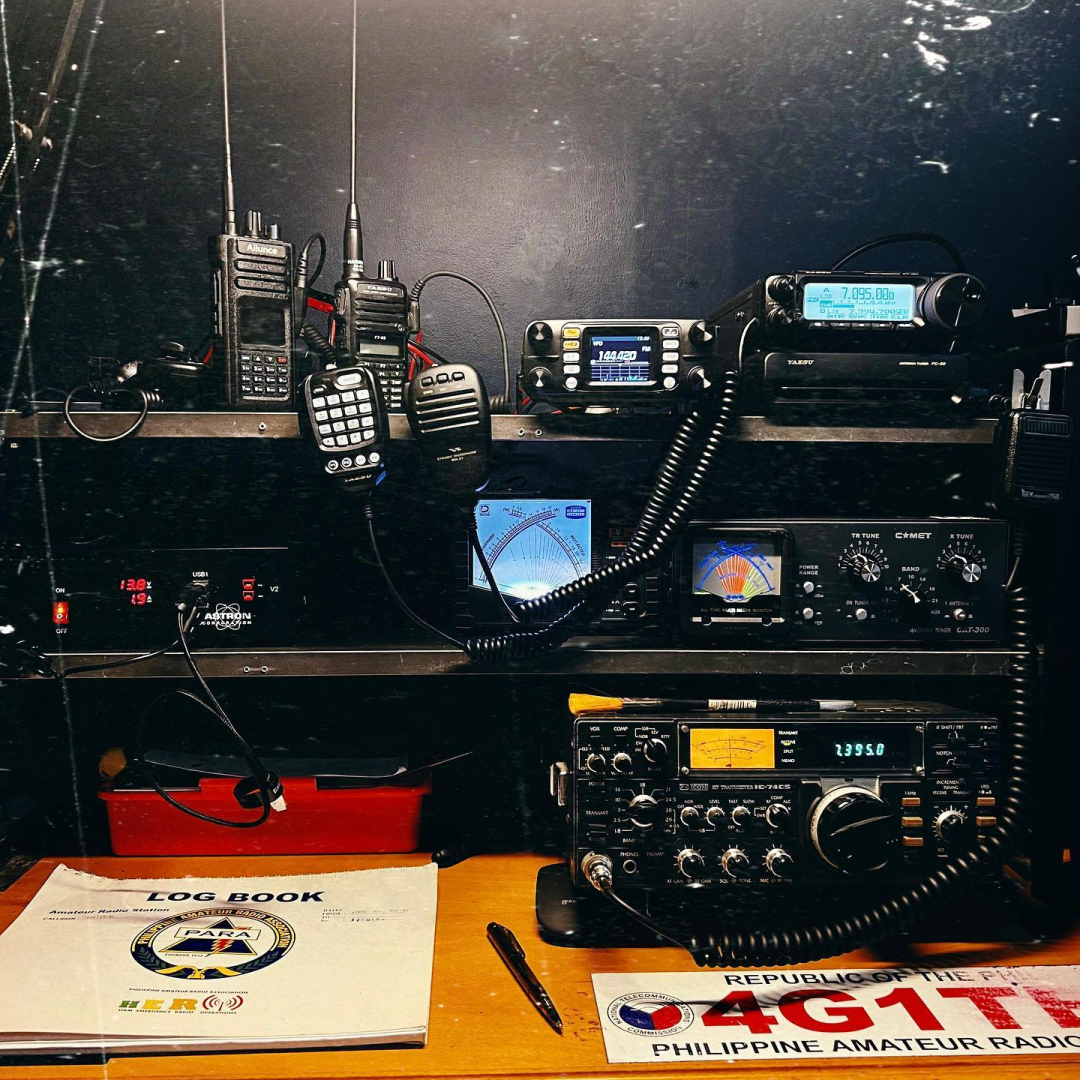
Did you know that the way you install your antenna can affect how well you receive signals?
Jan 26,2026 | yategood
Installing an antenna is something almost every radio enthusiast needs to do. And in fact, everyone is quite adept at it. A mobile radio? Just use a suction cup. Shortwave? Hang it on a pole. While you do these things, have you ever thought about why you do them this way? Could I use a pole to hang a UV-band antenna—or use a suction cup to mount a telescopic antenna to the car? Wouldn't that affect the performance?
An antenna on a car roof
First, you need to understand what your antenna is actually for. Different antenna installation methods will affect the properties of the radio waves emitted from the antenna. We all know that radio waves propagate in space as electromagnetic waves, creating electric and magnetic fields during propagation. These fields are perpendicular to each other (by the way, this is also a test point in the Academic Level exam). Based on the relative relationship between the electric field vector and the ground, we can distinguish the different properties of the radio waves, which is what we usually call "polarization."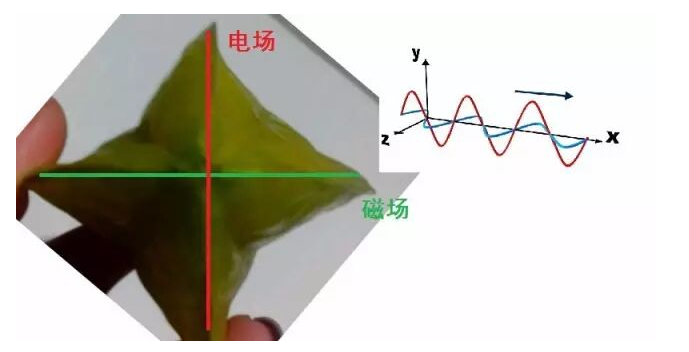
Do you know how much effort I put into finding a starfruit with four corners…
To use an imperfect analogy, it's like holding a starfruit with only four corners and looking at its cross-section relative to the ground. If one diagonal line represents the electric field plane, the other should represent the magnetic field plane. Considering the relationship between the electric field plane and the ground, we naturally have two classification methods: horizontal and vertical. If we consider rotation, we get an additional rotational form. Applying these concepts to electromagnetic waves, we get the following polarization forms—horizontal polarization, vertical polarization, and circular polarization. All other polarization modes are combinations of these.
In horizontal and vertical polarization, the waveform of a radio wave and its projection onto a cross-section are different.
So what polarization do the antennas we commonly use employ? For example, the upright antennas commonly used in mobile radios transmit radio waves, forming vertically polarized waves, where the electric field direction is perpendicular to the ground. In UV-band amateur radio communication, almost 99% of antennas are vertically polarized. For line-of-sight radio waves like those in the UV band, the polarization does not change during propagation. Therefore, maintaining the same polarization for both transmission and reception ensures the best results and avoids signal loss.
Vehicle-mounted shortwave antennas are also vertically polarized, primarily to reduce wind resistance and facilitate installation.
This provides guidance for installing UV-band antennas and Yagi antennas for base stations. If you want to install a vehicle-mounted radio at home, using a combination of a vehicle-mounted suction cup and a vertical antenna, simply mount it vertically outdoors, just like you would in a car. If you are using a Yagi antenna, you must ensure that the polarization direction of the Yagi is adjusted to be vertical, i.e., the vibrator is vertical ("the fishbone is standing up"). This ensures that the radio waves are vertically polarized.
Yagi antennas can be both vertically and horizontally polarized.
So, what about shortwave? Why can both vertical and horizontal antennas be used on shortwave, and why are there so many users of both types?
Shortwave propagation involves reflection from the ionosphere, so the waves are affected by this reflection. The state of the ionosphere is constantly changing, affecting the polarization of the waves. If you're using a horizontally polarized Yagi antenna, it's very likely that it will have become vertically polarized by the time it reaches the receiver (or even worse, a completely different polarization). In this case, we can't consider the impact of different polarizations on reception; we just need to try our best to receive the signal. However, because the power of shortwave antennas is generally not low, different polarizations don't significantly affect signal transmission. One point to note is that most electromagnetic noise generated by human activity is vertically polarized; using a horizontally polarized antenna can effectively reduce the amount of noise received.
Long-distance VHF DX enthusiasts often use horizontally polarized Yagi antennas.
Are there any exceptions? Generally, enthusiasts using SSB or CW modes in the UV band tend to mount their antennas horizontally polarized to reduce receiver noise and to connect with other enthusiasts using horizontal polarization during DX events. However, if you don't mind a few dB of loss, using horizontal polarization for regular communication is perfectly fine.
Complex shortwave log-periodic antennas
To achieve the best results, various antenna polarization methods have been chosen. If you want the best communication performance, maintaining the same antenna polarization as most of your communication targets is the best choice. Understand? https://yategood.com/products/gx7walkie-talkies-best
टिप्पणी