If cell phones are so good, why do we still need walkie-talkies?
Jun 16,2026 | yategood
It's 2026, and cell phones are so convenient, so why are people still using walkie-talkies?
That's because walkie-talkies don't rely on the internet, don't incur call charges, and connect instantly. Therefore, walkie-talkies will always have a place in the world of communication devices.
What is a walkie-talkie?
Communication signals are invisible radio waves that are constantly being sent and received in the air. An old-fashioned radio is a device that can only receive radio waves. A walkie-talkie (two-way radio) is a device that can both receive and send radio waves. A walkie-talkie with high power, large size, and fixed in one place (vehicle, ship) is called a radio station. A walkie-talkie with low power, small size, and that can be carried around is called a handheld walkie-talkie, which is also the most common type of walkie-talkie we see.
The communication process of a walkie-talkie and a mobile phone is similar: receiving input (voice or text) ---> processing information (encoding the input into a signal) ---> transmitting the signal (sent to another walkie-talkie or sent to an application server via the operator's network).
The process of speaking on a walkie-talkie (using a common circuit as an example) is as follows: Similar to sending a voice message on WeChat, you need to continuously press and hold the PTT (PUSH TO TALK) button to speak. After the sound is picked up by the microphone, it is converted into an audio electrical signal.
The processor inside the walkie-talkie processes the electrical signal, generates the transmitted radio frequency carrier signal, and uses buffer amplification, excitation amplification, power amplification, etc., to form the rated radio frequency power.
The transceiver bandpass filter suppresses harmonic components in the electrical signal, and the signal is transmitted through the antenna.
The process of answering a call on a walkie-talkie and a mobile phone is similar: receiving a signal (from another walkie-talkie or an application server) ---> processing information (decoding the signal into voice or multimedia) ---> output display.
The process of answering a walkie-talkie (using a common circuit as an example) is as follows: After being powered on, the walkie-talkie is constantly receiving signals.
Once information is received from the antenna, the signal is processed:
The amplified signal from the radio frequency (RF) is mixed with the first local oscillator signal from the phase-locked loop (PLL) frequency synthesizer circuit at the first mixer to generate the first intermediate frequency (IF) signal.
The first IF signal is further filtered by a crystal filter to eliminate adjacent channel noise, and then enters the IF processing chip, where it is mixed again with the second RF signal from the PLL frequency synthesizer circuit to generate the second IF signal.
The second IF signal is filtered by a ceramic filter to remove unwanted spurious signals, then amplified and frequency-discriminated to generate an audio signal.
The audio signal is processed by circuits such as amplification, bandpass filtering, and de-emphasis to convert it into audio.
The volume control circuit and power amplifier amplify the audio and drive the speaker to play the audio.
Features of walkie-talkies
Not Relying on Networks
Mobile phone communication requires the support of various networks, including: wireless access networks, bearer networks, core networks, and external networks. Only such a vast and complex network can support smooth calls and a good internet experience for billions of mobile phones. For those interested in network support, you can read "Love Isn't That Easy; Everyone Has a Mobile Phone."
Communication between walkie-talkies doesn't require as much network. Two walkie-talkies that have established a communication channel can talk freely by simply pressing the talk button. If multiple walkie-talkies are on the same channel, when one walkie-talkie starts speaking, all the other walkie-talkies can hear the sound.
Instant Connection
When a mobile phone makes a call, the signal needs to be processed by the communication network: the other party's phone is located and rings, and only after the other party answers can the two parties officially begin talking. While this process is already fast, walkie-talkies can be even faster: the two parties can talk the moment the call button is pressed, minimizing the waiting time before the call is answered. In specific scenarios requiring rapid response, walkie-talkies can greatly improve communication efficiency, allowing tasks requiring teamwork to be completed effectively under unified command and coordinated action.
Operating Frequency Bands The operating frequency bands for walkie-talkies are allocated and managed by the China Radio Management Committee. According to regulations, professional walkie-talkies use the VHF band (136 MHz~174 MHz) and the UHF band (400 MHz~470 MHz); outdoor hiking uses 433 MHz; mobile phones use 900 MHz/1800 MHz; and civilian use uses 409 MHz~410 MHz. Although there are many operating frequency bands, the bands we use in daily life are 409 MHz~410 MHz. It is crucial not to use other frequency bands beyond the regulations to avoid interfering with other users in the designated frequency bands.
Communication Channels Based on fixed step sizes (e.g., 25 kHz (wideband), 20 kHz, 12.5 kHz (narrowband)), the operating frequency band can be divided into multiple communication channels, such as: 409.7500 MHz, 409.7625 MHz, 409.7750 MHz, 409.7875 MHz, and 409.8000 MHz. Walkie-talkies most commonly use 20 channels between 409.7500 MHz and 409.9875 MHz.
With so many communication channels, do we need to try them one by one? Of course not. Walkie-talkies offer a channel scanning function: a dedicated button, when pressed, will cause the walkie-talkie to attempt to receive signals from each communication channel in a specific order. If each channel is tested for 100 ms, it can attempt to scan 10 communication channels per second, resulting in a scanning speed of 10 ch/s.
Transmit Power: Power is an important indicator of a walkie-talkie. The higher the power, the greater the communication range between two walkie-talkies. Civilian walkie-talkies typically have a power rating of less than 0.5 watts; walkie-talkies exceeding 0.5 watts require a radio license to operate. Handheld walkie-talkies generally have a power rating of less than 5 watts, while vehicle-mounted and ship-mounted radios have higher power ratings, ranging from 25 watts to 50 watts, and some even reach 100 watts.
**Communication Range**
When walkie-talkies rely solely on their own transmission and reception of radio waves, the communication distance between two walkie-talkies is affected by various factors such as power and obstacles. In open environments, handheld walkie-talkies can maintain clear communication quality within a range of 0-3 kilometers. In urban environments with numerous tall buildings, the optimal communication range for handheld walkie-talkies is within 1-2 kilometers.
**Antenna**
We know that the higher the frequency of a radio wave, the shorter its wavelength, and consequently, the shorter the receiving antenna. Because walkie-talkies operate at relatively low frequencies, a longer antenna is required to receive radio waves. Therefore, when you see a handheld device with a "long ear," it is most likely a walkie-talkie.
**Battery**
To achieve longer battery life, walkie-talkies are equipped with large-capacity batteries and automatic power-saving functions. If a walkie-talkie does not transmit a signal for an extended period, it will automatically "sleep" for a period of time until it receives a new signal or is activated by a button, at which point it will "wake up" and resume normal operation.
Structure: The walkie-talkie has a simple structure, and in order to be used in complex outdoor environments, it is also designed with waterproof, shockproof and other functions, making it sturdy and durable.
Application scenarios of walkie-talkies
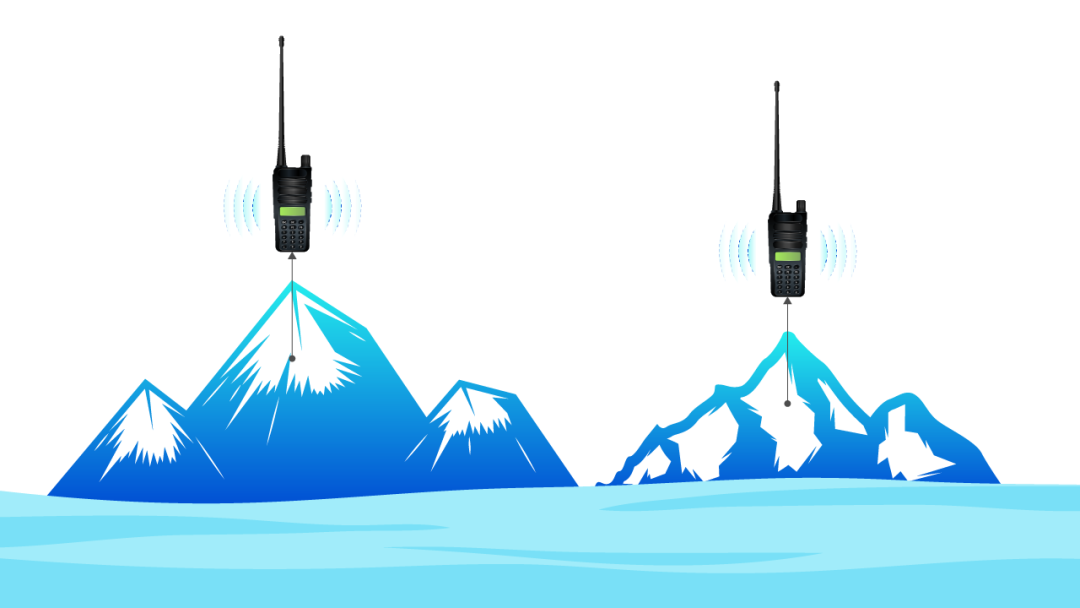
Outdoors, Basements, Tunnels
Although telecommunications networks have covered a large area of the earth, there are still environments where base stations may not yet be available, such as outdoors, basements, and tunnels. These are where walkie-talkies can be very useful.
Medical Facilities, Shopping Malls, Large Event Venues
In these environments where time is of the essence and efficiency is paramount, the simplicity and directness of walkie-talkies make communication faster and more effective.
Walkie-talkies have undergone numerous transformations since their invention. Current types include:
* **Traditional Walkie-Talkies:** The earliest and most widely used type, they use analog signals, primarily modulated onto the walkie-talkie's communication frequency band. Two walkie-talkies need to use the same communication channel within range to communicate successfully.
* **Digital Walkie-Talkies:** These use digital signals, converting voice into digital codes for transmission between different walkie-talkies. This effectively avoids noise and distortion during communication. They employ time division multiple access (TDMA), allowing multiple users to use the same frequency band simultaneously, thus increasing communication capacity and enabling one walkie-talkie to communicate with more other walkie-talkies.
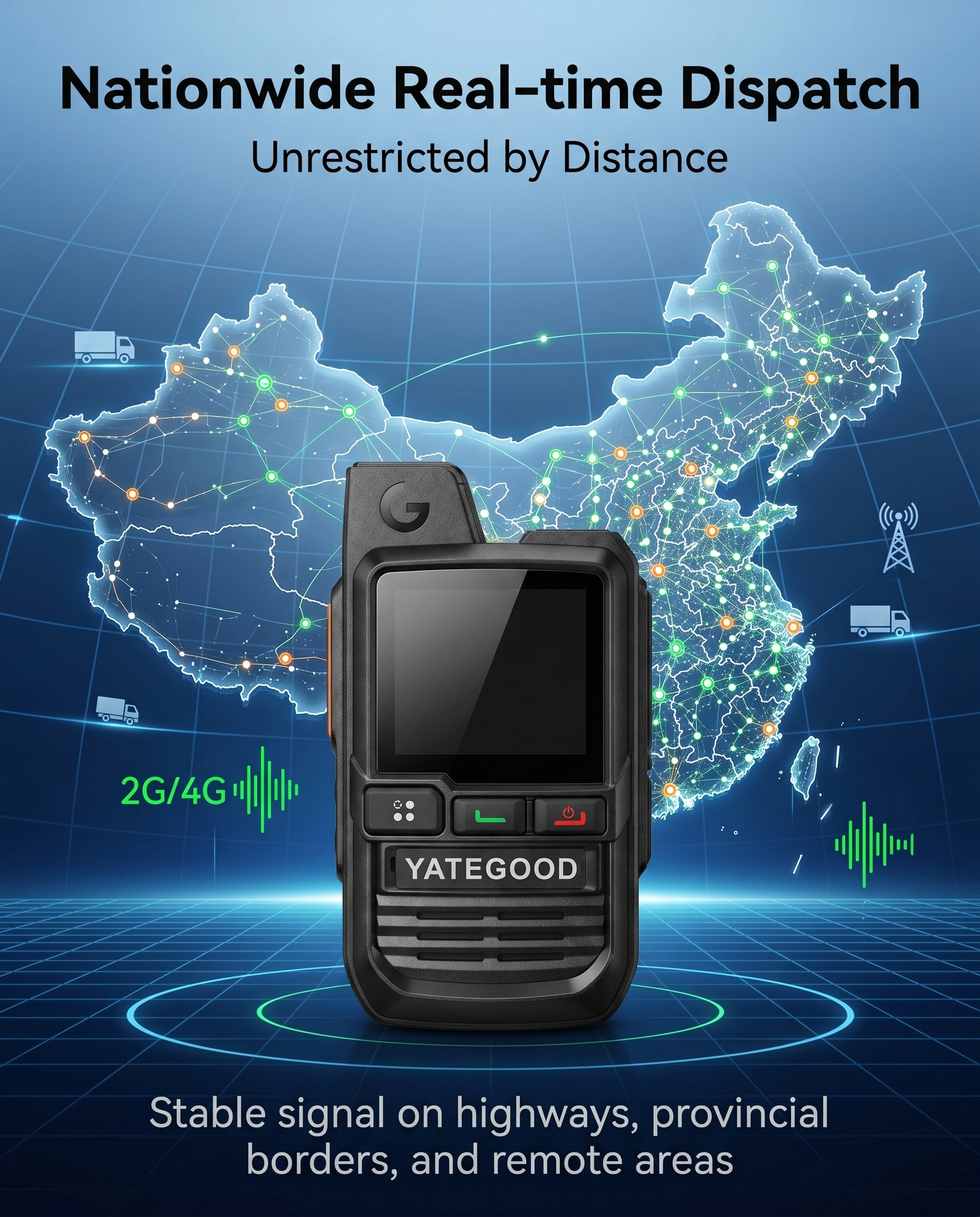
* **IP Walkie-Talkies (Public Network Walkie-Talkies):** These connect the walkie-talkie to our existing communication network, extending the communication distance. With the addition of an IoT card, the maximum communication distance can exceed 5000 kilometers. In addition to the original long antenna, public network walkie-talkies have an extra antenna specifically for establishing communication with the base station. However, since mobile phone communication frequencies are much higher than those of walkie-talkies, the added antenna is relatively short and can be completely hidden inside the walkie-talkie. IP walkie-talkies use existing communication networks to make calls, making them essentially no different from mobile phones.
Comment
.png?w=1254&h=1254)