The Indispensability of Walkie-Talkies
Jun 26,2026 | yategood
The Indispensability of Walkie-Talkies.
With telephones and WeChat being so convenient and ubiquitous, why are walkie-talkies still indispensable?
The core advantage of telephones lies in one-on-one private communication, which can accurately convey emotions and has a low operating threshold, making it suitable for all ages. However, multiple people need to make repeated calls for collaboration, and one-on-one communication is inefficient. In addition, the dialing waiting process can easily delay the opportunity in emergency scenarios. WeChat is good at communication in multiple forms (text, images, audio and video, files), information can be stored, and communication costs are low. However, it has problems such as insufficient real-time performance and information can easily pile up. It also requires unlocking the screen and searching for the chat box, which limits its use when both hands are occupied.
Walkie-talkies perfectly fill the gaps between the two, with their core advantages being extremely simple operation, efficient communication, and versatility in various scenarios, making them an irreplaceable choice for special situations:
In terms of operation, all types of walkie-talkies maintain the extremely simple logic of "pressing the PTT button to speak and get through instantly," eliminating the need to unlock the screen, search for contacts, or wait to dial. Even when hands are busy (such as carrying equipment outdoors or working on a construction site), communication can be quick and efficient without compromising safety..
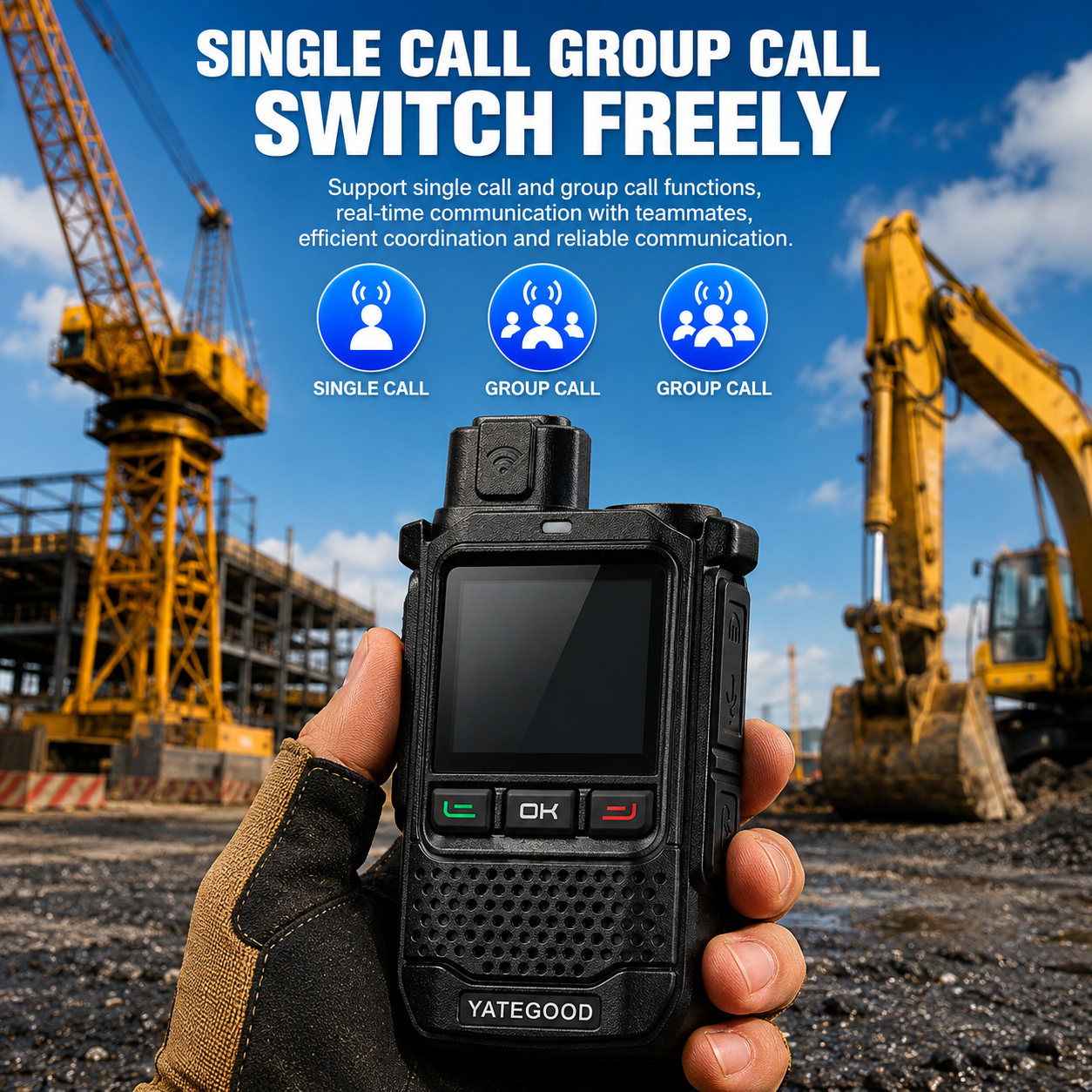
In terms of communication, it naturally supports "one person speaks, everyone knows", and synchronizes instructions with zero delay when multiple people collaborate (logistics scheduling, park inspection, event execution), avoiding information omissions; especially in emergency rescue scenarios, there is no need to wait for dialing, PTT can quickly assemble personnel and synchronize plans with one click, which is faster than telephone response and has become the preferred communication tool in emergency scenarios..
In terms of scenario adaptability, a diverse product portfolio covers all needs: public network walkie-talkies break the traditional distance limitations of walkie-talkies, ensuring smooth communication across cities and long distances, perfectly adapting to fleet self-driving and cross-regional collaboration; analog walkie-talkies do not rely on the public network and maintain stable communication in environments with weak signals such as tunnels and underground parking garages; satellite walkie-talkies can achieve communication in harsh environments with no signal, such as uninhabited areas and remote operations; dual-mode (analog + public network) and public network + satellite composite products can better cope with scenario switching and balance distance and signal stability.
In short, when communication needs focus on "emergency response, real-time collaboration among multiple people, inconvenient operation with both hands, and communication in complex environments," the unique advantages of walkie-talkies cannot be replaced by telephones or WeChat, making them an essential requirement for efficient communication in special scenarios.
Comment
.png?w=1254&h=1254)